
Why can’t tree-huggers & forest destroyers get along?
I lived in the wilds of southern Oregon for 17 years. I enjoyed many things about life in the forest. One of the things I loved most was watching the politics. Our community was polarized before polarization was cool. Loggers versus environmentalists, sure, but also weird alliances. Open-carry fisherman cozying up to tree huggers to save the salmon & steelhead. Rugged loggers cozying up to (relatively) soft townies with money.
My roots went deep in the area, one set of grandparents having moved there in 1943. The other grandparents (that grandfather was a former mayor & city councilor) moved there in 1933. I felt connected & invested, even if I didn’t usually stick my ideas out there.
Gridlock
The one time I did put my 2 cents in (this is back when we had cents) was when I tried to resolve the absolute hatred between environmentalists & loggers using what I was studying about incentive structures. I think the system I came up with was cool but it quickly disappeared, so now I want to put it in public permanently here.
Here’s the setup:
Only 5% of the old-growth forest was left.
Loggers wanted to harvest all of it.
Environmentalists wanted all logging to stop.
Second-growth forest was prone to catastrophic wild fires. (There’s a special kind of helpless feeling watching a fire approach your home.)
Loggers wanted to harvest second-growth.
Environmentalists wanted all logging to stop.
The result was a complete impasse. Forests burning. Mills closing. Crime & drugs up. Anybody with any ambition leaving. Nobody was getting what they wanted—loggers, environmentalists, workers.
(Or at least what they said they wanted—there seemed to be a bunch of psychodramas playing out.)
Incentives
I recast the forest tinning situation as an incentives problem (I was intensively studying incentives at the time). Once the loggers finally got permission to harvest a tract of second-growth, they were incentivized to take out every stick of wood with economic value, leaving further growth stunted, encouraging the growth of flammable underbrush.
Because environmentalists saw the loggers’ incentives, they were ever more incentivized to block all logging & put onerous restrictions on any activity that managed to sneak through. In Influence Diagram terms, more logging leads to more money & more damage, but more damage leads to more resistance leads to less logging.
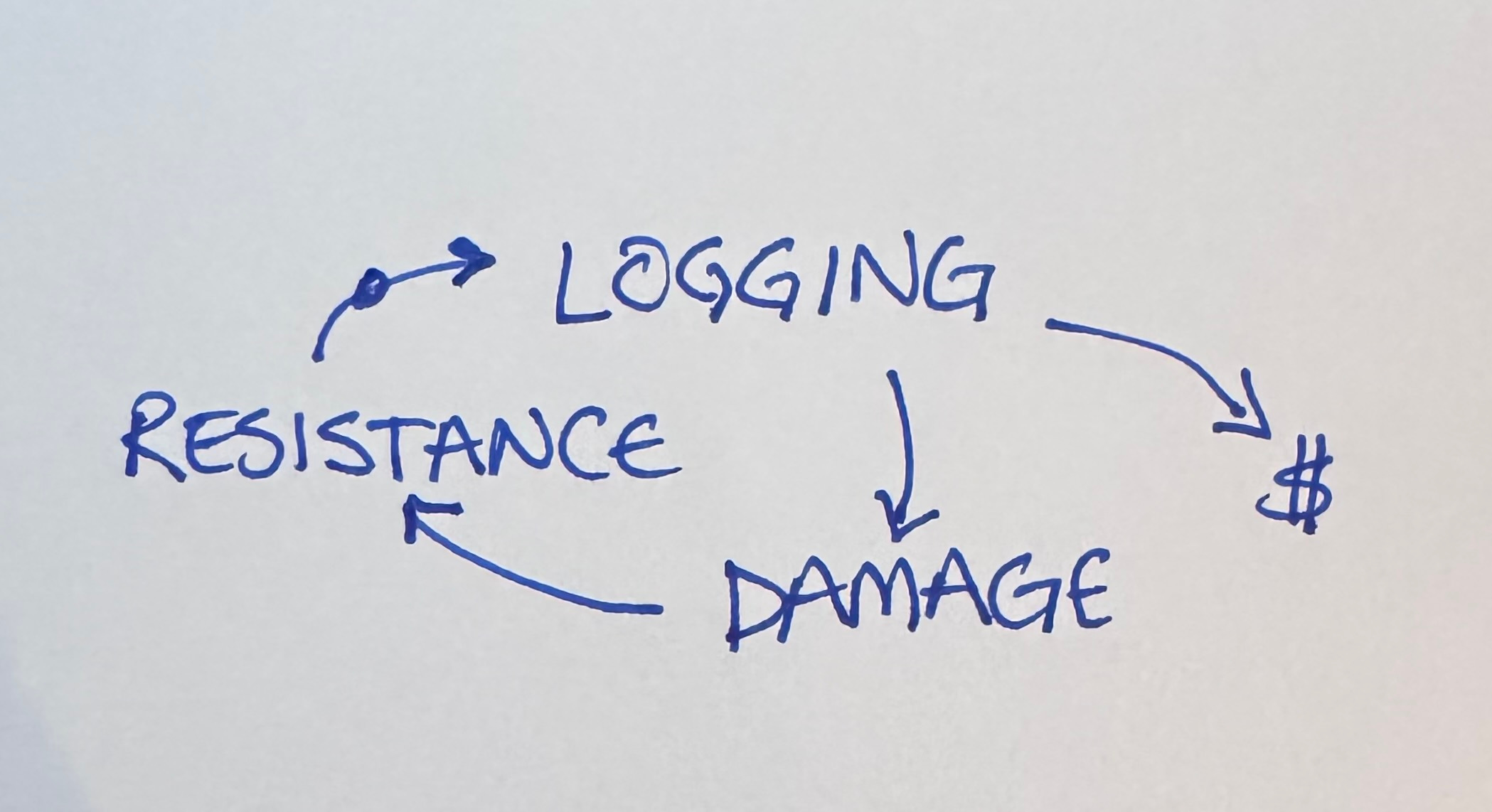
Classic inhibiting loop. More logging leads to less logging. (We could go on & on mapping this system, but this will do to illustrate my pr of the many interventions we can make in a system is to speed or slow feedback. What if, instead of getting paid for this harvest, the loggers got paid for the next harvest. Today they’d thin the forest, with any valuable material going to be turned into products, but it wasn’t until 10 years later that they would be paid the proceeds of the next forest thinning. You would get paid more if the forest thrived over the next 10 years, less if it grew less.
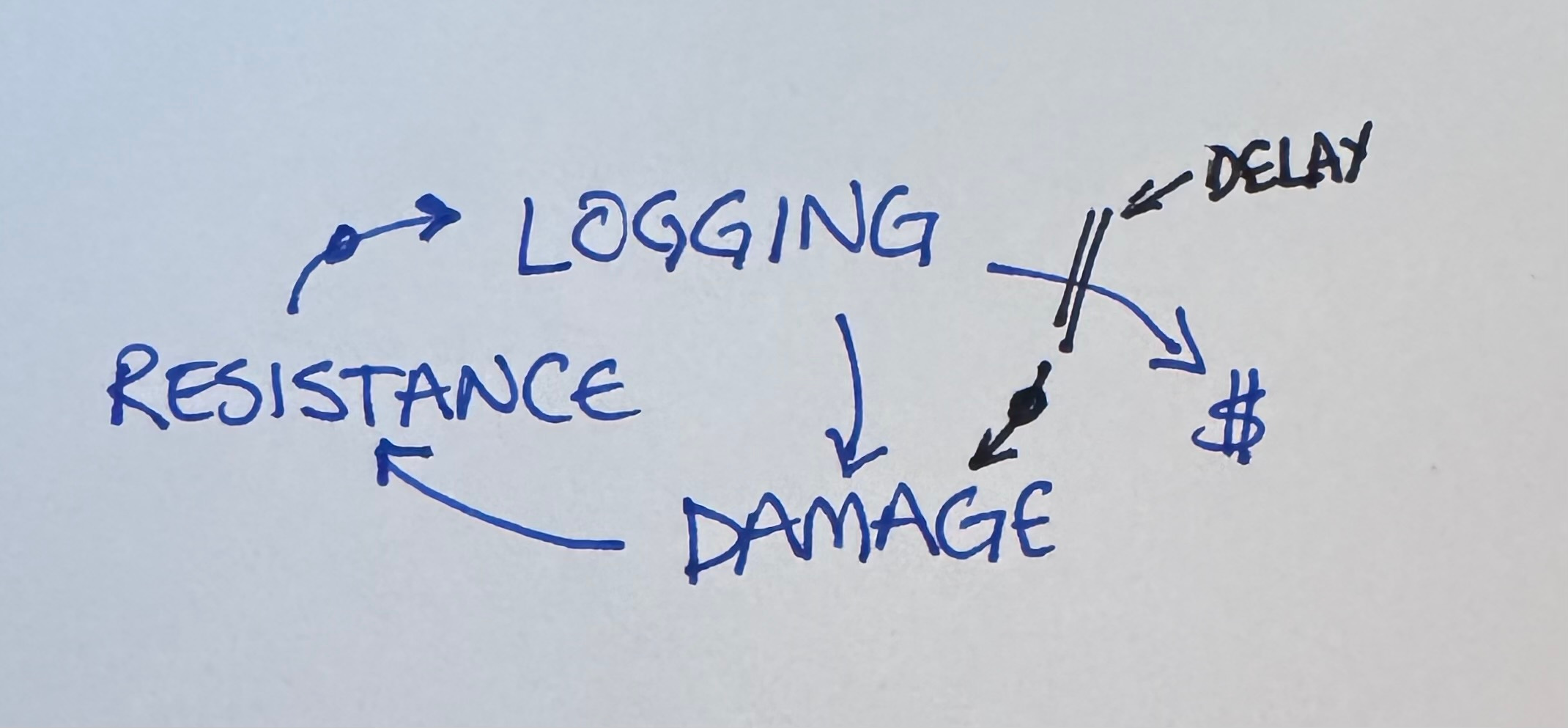
(I think I kind of made up the notation for delay.)
Now we have a reinforcing loop. More logging. Less damage (because the loggers get paid in a decade). Less resistance. More logging (in the form of forest thinning.)
Priming the Pump
That first logger, how do they get paid? They are paying for diesel, salaries, depreciation today & won’t get money for 10 years. The right to be paid in 10 years can be turned into a financial instrument to be sold today (remember those soft townies with money?) Now you have monied interests who also care about the forest’s health.
And who is best suited to evaluate the health of the forest for future gain (and avoiding future loss from pests or fire)? Well, those environmentalists who care so about the forest are well positioned to act as consultants & auditors.
Mill workers would be back at work. Local capital would have another way to extract rents. Environmentalists would have healthier forests. Loggers would have trees to cut.
Chickening Out
I wrote the above up as a letter to the editor of the local newspaper. That got me invited to a “summit” of conservationists & loggers. When the microphone got around to me I had an attack of shyness, said something self-deprecating, and passed the mic on to the next person. So that was that.
Would it have worked? Maybe. Entrenched interests were more interested in staying entrenched than in making progress. That’s true today in many situations I see. It’s not as simple as “change the rules and the behavior will change”. But “don’t change the rules & the behavior will definitely not change”.
Kent partners with a handful of companies each year on editorial collaborations, speaking, and workshops. If that's interesting, let's talk →
Interesting story and I appreciate your courage to share it.
The delay in payment would seem like the biggest hurdle here although your idea of selling futures is innovative. The ones holding the futures would be depending on the careful cutting of the loggers today who would have walked away at that point. So I think that would be a potential failure point.
I think most people cannot plan one year in advance much less ten.
Just curious, how many tree planters are there today? We plant not for ourselves but for the future generations.